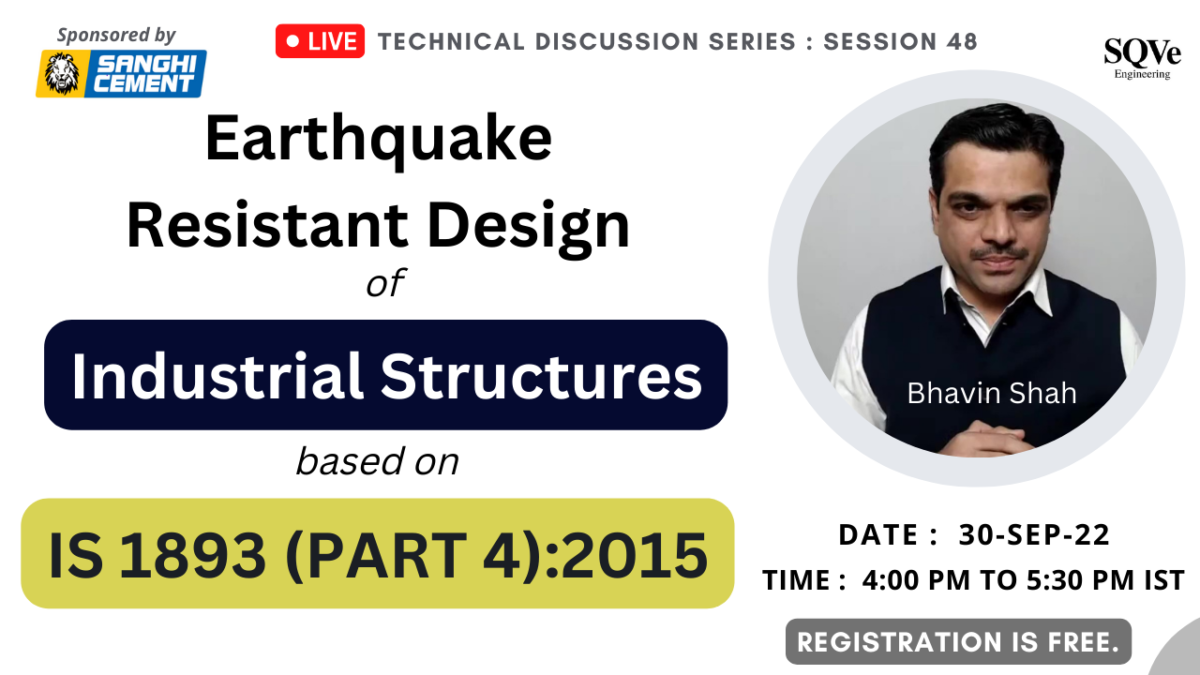
Industrial structures are highly irregular to meet the functional requirements and hence they are vulnerable to the seismic events. For earthquake resistant design of industrial structures, IS 1893 (Part 4) : 2015 needs to be followed. Around 2021, the revised draft code was circulated by BIS. However, the updated code has not been issued yet.
We have received numbers of request from engineers to conduct live technical discussion related to earthquake resistant design of industrial structures based on IS 1893 (Part 4):2015. Accordingly, the live discussion is arranged as follows:
The session will be conducted by Bhavin Shah (Founder & CEO, SQVe Consultants).
Please share the queries / discussion points related to IS 1893 (Part 4) in the following registration form. It would help us to structure the discussion.
The event is sponsored by Sanghi Cement.
Schedule
DATE : 30-SEP-22
TIME : 4:00 PM TO 5:30 PM IST
HOW TO REGISTER FOR THE EVENT?
Registration is FREE.
Please share the queries / discussion points related to IS 1893 (Part 4) in the following registration form. It would help us to structure the discussion.
STEEL-STR-002 : ONLINE WORKSHOP – Design of connections for steel structures
Learn fundamental and the concepts related to steel connection design based on Eurocode-3, AISC 360-16 & IS 800:2007. Hands-on practice will be organised by installation of RAM connection software in the system of registered participants. The workshop will commence from 3-OCT-22.
Recently, BIS published the amendments related to IS 1893 (Part 1) : 2016 & IS 13920 in November, 2020. The article shows some of the major changes made in the code as per my understanding. Only brief details are mentioned below, for details please refer the amendments.
Amendment no. 2 of IS 1893 (Part 1) : 2016
1. Clause related to vertical earthquake shaking is modified. The requirements are added for embankments, dams, bridges, etc. Also, the criteria for consideration of vertical earthquake shaking are modified.
2. The methodology for calculation of torsional irregularity is updated. The maximum displacement should be checked against the average displacement as against the minimum displacement in the previous version of the code. For more details, please refer the amendment.
3. For a building with re-entrant corners, three dimensional dynamic analysis to be performed with the flexible floor diaphragm. If there is a rigid diaphragm in the building then two separate analysis to be performed, firstly with flexible diaphragm and secondly with the rigid diaphragm. The worst effects to be considered from both the analysis.
4. For out of plane offset in vertical elements, the forces and moments due to earthquake effects in the elements connecting the two vertical elements with out of plane offset elements, the vertical element supporting the offset, and connections shall be enhanced by a factor of at least 2.5.
5. The provisions for stiffness irregularity are further clarified and few changes are made as well. In the note, it is mentioned that this provision is not applicable to such storeys, which have: (a) lower height, where services and utilities are housed, or (b) outrigger frame members placed in them.
6. For weak storey irregularity – buildings with strength irregularity shall not be permitted. In case, the weak storey is because of URM infills, provisions of 7.10 shall be followed.
7. Floating columns – Such columns are likely to cause concentrated damage in the structure, and are undesirable. A building with floating columns shall not be permitted, if the floating columns are part of or supporting the primary lateral load resisting system.’
8. Irregularity related to “Irregular Modes of Oscillation in Two Principal Plan Directions” is further clarified. It is also mentioned that this provision is not applicable to buildings with large podiums in the lower storeys.
9. For importance factor, “school” is replaced with the “educational building”.
10. OBF is not allowed in seismic zone III, IV & V.
11. Provisions for flat slab – structural wall system are further clarified.
12. Formula for Aw is modified and now it is same as when the code was published in 2016. It is mentioned that The value of Ta obtained shall neither be taken to be more than that given in 7.6.2 (a) nor less than that given in 7.6.2 (c).
13. In case of URM, RC members shall be designed for the governing combinations of stress resultants arising from structural analysis of:
a) Bare frame building, and
b) Frame building with URM infills.
14. For other details, please refer the amendment.
Amendment no. 2 ofIS 13920 : 2016
1. Steel reinforcement shall comply with all of the following:
a) Elongation shall be at least 14.5 percent,
b) Ratio of ultimate stress to 0.2 percent proof stress shall not exceed 1.25,
c) Ratio of ultimate stress to 0.2 percent proof stress shall be at least 1.15, and
d) Steel shall be only of strength grades with minimum 0.2 percent proof stress of 415 MPa, 500 MPa or 550 MPa, in addition to other requirements of IS 1786.’
2. In cl no. 9.1.1, modifications are made for calculation of nominal shear strength of concrete in a beam-column joint.
3. In cl no. 9.1.2, provisions related to design shear stress demand are further clarified.
4. For other details, please refer the amendment.
We are planning live technical discussion for the amendments on 20-DEC-20 at 11:00AM IST. Please share your comments / discussion points in the below comment box. We will discuss the same during live session of 20-DEC-20.
Link of the live session is attached below. Please like and share this video with the interested engineers in your circle.
Session 11 : Recent amendments for IS 1893 (Part 1):2016 and IS 13920:2016 – Live discussion
An online course related to earthquake resistant design will start from 17-MAR-22. Please watch the introductory video below:
EQ-STR-002 : Learn concepts of earthquake resistant design
Click below for more details and registration for EQ-STR-002
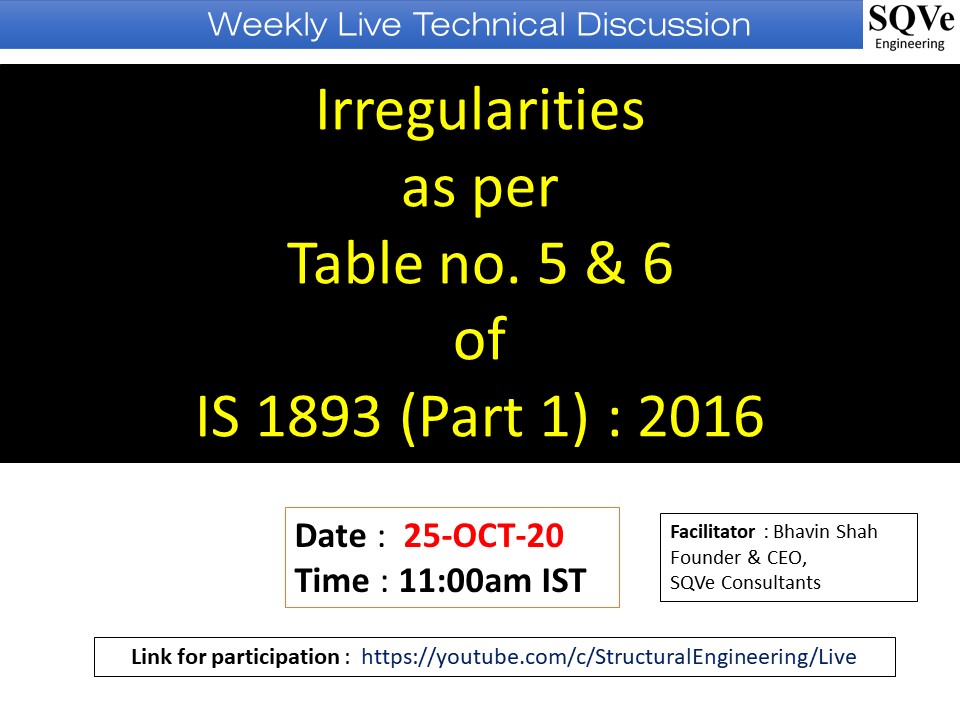
I have received suggestions from engineers to take up the discussion on irregularities as per table no. 5 &6 of IS 1893 (Part 1) : 2016.
It is a well established fact that the regular building perform better than the irregular buildings during seismic event. In IS 1893 (Part 1) : 2016, plan and vertical irregularities are defined in Table no. 5 & 6 of the code. The building is said to be irregular if any one of the irregularity is present in the building. It is mentioned in the code that all the efforts shall be made to eliminate irregularities by modifying architectural planning and structural configurations.
For each irregularity, mathematical limits are defined in the code as well as further action is detailed out whenever the irregularity exceeds the defined limits.
Table no. 5 – Plan irregularities :
Torsional irregularity
Re-entrant corners
Floor slabs having excessive cut-outs or opening
Out-of-plane offsets in vertical elements
Non-parallel lateral force system
Table no. 6 – Vertical irregularities :
Stiffness irregularity (Soft storey)
Mass irregularity
Vertical geometric irregularity
In-plane discontinuity in Vertical elements resisting lateral force
Strength irregularity (Weak storey)
Floating or stub columns
Irregular modes of oscillation in two principal plan directions
We will discuss each irregularity in detail during live technical discussion. The participants will also share their experiences related to the table no. 5 & 6 of the code.
You may share the specific queries / discussion point which may be taken up during live technical discussion.
Join us on next Sunday (25-Oct-20) for live technical discussion on different irregularities as per table no. 5 and 6 of IS 1893 (Part 1) : 2016. Please share discussion points for the same in the comment box. You may also circulate this message with the interested engineers in your circle.
Session no. 7 – Irregularities as per Table no. 5 & 6 of IS 1893 (Part 1) : 2016
Facilitator : Bhavin Shah, Founder & CEO – SQVe Consultants